A Quick Reality Check from My Lab
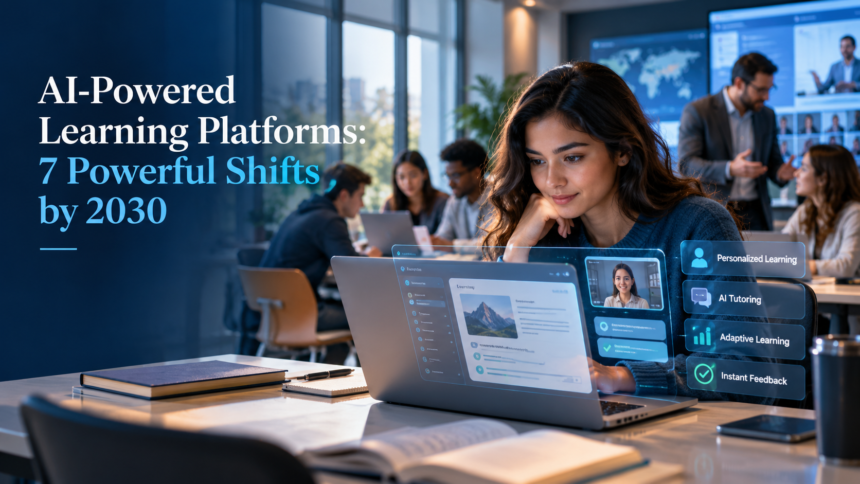
AI-powered learning platforms are reshaping Education Technology (EdTech) by combining adaptive learning, personalized feedback, automation, and data-driven instruction. As Generative AI in Education develops, the role of traditional teaching is also changing, raising important questions about how AI and human teachers may work together by 2030. The debate is no longer simply about whether AI can teach, but about which parts of education AI can improve and where human teachers remain essential.
Before we dive into the stats, let me share something personal. Last week, while I was fine-tuning a learning model, I realized something startling. We often talk about “AI vs. Humans” as if it’s a boxing match. But sitting there at 2 AM, debugging code, I felt that AI wasn’t replacing my curiosity; it was just removing the friction. This article isn’t just another tech prediction—it’s a reflection of what I see happening on the ground as an engineer.
Updated for April 2026: This article reflects the latest shift in AI-powered education, online learning behavior, and the evolving role of human teachers in a rapidly changing digital world.
Let’s be honest for a second. When people hear about an AI-powered learning platform, they usually think, “Okay, sounds interesting… but can it really replace real teachers?”
Here’s the truth: the strong AI in the Education Market is growing faster than most people expected. Students are learning smarter, professionals are upgrading skills faster, and AI tutors are quietly becoming powerful learning companions.
So the real question is not “if” — but “how far” this will go by 2030.
👉 Key Takeaway: AI is likely to dominate repetition, instant doubt-solving, and personalized learning, while human teachers will remain essential for mentorship, emotional support, and real-world guidance.
What Are AI-Powered Learning Platforms?
AI-powered learning platforms are intelligent systems that personalize learning using data, automation, and machine learning.For a broader perspective on how AI is being integrated into education, see UNESCO’s guidance on AI and education
Instead of one-size-fits-all teaching, they adjust:
- Learning speed
- Difficulty level
- Content type
They include:
- AI tutors
- Adaptive learning systems
- AI education tools
- Digital classrooms
- Virtual learning platforms
My Take as an AI Engineer: I get asked this a lot: “Can AI truly understand a student’s frustration?” Honestly? No. It can detect patterns of frustration through data, but it doesn’t “feel” the breakthrough moment when a student finally understands a complex concept. In my view, the 2030 landscape will be less about “AI teachers” and more about “AI-augmented mentors.” We are building the tools, but we can’t build the soul of mentorship.

Simple truth: AI doesn’t just teach — it adapts.
Why the AI in Education Market Is Exploding
The AI in Education Market is booming for one simple reason: people want faster, smarter learning.
Let me share a real observation: Most learners today don’t want 3-hour lectures. They want instant answers, clear explanations, and personalized guidance.
And that’s exactly what AI delivers:
- 24/7 availability
- Low-cost learning
- Instant feedback
- Personalized learning with AI
Opinion: AI won’t destroy education — but it will definitely transform it.
Human insight: Many people assume AI will replace teachers completely. In reality, students don’t just need answers — they need confidence, direction, and someone who understands their struggles. That’s where human teaching still matters deeply.
How AI-Powered Learning Platforms Work
1. Data Tracking
AI tracks your behavior, performance, and mistakes.If you want to understand how modern AI systems process information and generate responses, read our guide to LLM Writing
2. Pattern Recognition
It identifies strengths and weak areas.
3. Personalization Engine
Content adjusts based on your level.
4. Instant Feedback
You get corrections immediately.
5. Continuous Improvement
The system gets smarter over time.
Reality check: The more you use it, the better it becomes.
Practical Implementation Guide
Step 1: Choose Platform
Use platforms like Coursera and Udemy.
Step 2: Set a Clear Goal
Skill learning, Career upgrade, Exam prep.
Step 3: Use AI Daily
Use AI study tools consistently.
Step 4: Track Progress
Review weekly performance.
Pro Insight: Consistency beats tools.
What to do next: Choose one AI learning platform, focus on a single skill, and use it consistently for 7 days. Then compare your speed, understanding, and retention with your traditional learning method.
In one line: AI excels in speed, scale, and personalization, while human teachers lead in emotional intelligence, mentorship, and deep understanding.
AI vs Human Teachers (Real Comparison)
| Item Name | Item Details / Key Features |
|---|---|
| AI-Powered Learning Platforms | Data tracking, 24/7 availability, instant feedback, and personalized learning speed. Excels in efficiency and scaling. |
| Human Teachers | Provide Emotional Intelligence (EQ), mentorship, real-world guidance, and critical thinking. Cannot be replicated by any AI algorithm. |
| Hybrid Learning 2030 | The future model where AI handles repetitive tasks, while human teachers focus on emotional support and deep mentorship. |
While machines excel at data, they lack Emotional Intelligence (EQ)—the core of human mentorship. The future isn’t about replacement; it’s about AI-Human Collaboration. In this new Personalized Learning era, the teacher’s role transforms from a lecturer to a high-level mentor, focusing on Critical Thinking and Social-Emotional Learning that no algorithm can replicate.
Truth: AI wins in efficiency; humans win in emotion.
Expert Tips
- Combine AI + human learning
- Use AI for repetition
- Don’t depend fully on AI
- Focus on skills
- Stay consistent
Common Mistakes
Myth: If AI becomes more advanced, human teachers will become irrelevant.
Reality: As AI handles repetitive tasks, the value of human mentorship and personalized guidance will actually increase.
- Over-dependence on AI
- Ignoring human interaction
- Using too many tools
Myth Break: AI alone won’t make you smarter.
Future of Education by 2030
Prediction: By 2030, the most successful education systems will combine AI-powered personalization with human mentoring, creating a hybrid learning model that delivers both efficiency and depth. This direction also aligns with broader research and policy discussions around AI, digital learning and the future of education from the OECD.
As AI becomes more capable of planning and completing tasks independently, AI agents could also become part of personalized learning workflows, helping students research, practice, and manage learning tasks more efficiently.
- AI tutors will become more human-like
- Hybrid learning will dominate
- AI classroom automation will grow
Future Insight: Early adopters will win big.

Quick Summary
- AI-Powered Learning Platforms are rising
- AI in Education Market is booming
- AI = speed, Humans = emotion
- Future = Hybrid learning
Think about this: If AI can explain faster, provide instant feedback, and stay available 24/7, what should human teachers focus on to stay relevant in the future?
Look, I’ll be blunt. If you’re a teacher who only recites textbooks, 2030 might be a tough year for you. But if you’re a mentor who inspires, no LLM or neural network can touch you. From where I stand, the future belongs to the “Hybrid Educator.” It’s a messy, exciting transition, and we’re all just trying to figure it out one prompt at a time.
Whether we like it or not, the Digital Transformation of schools is inevitable. By 2030, the most successful educators will be those who master AI Literacy. The question isn’t whether AI will take over, but how we can use this Disruptive Technology to empower the next generation without losing our human essence.
Final Conclusion
So… who wins? Honestly, it’s not AI vs humans. It’s AI + humans. And those who understand this early… will dominate the future.
Frequently Asked Questions
AI-powered learning platforms are digital education systems that use artificial intelligence, machine learning, and learner data to personalize lessons, adjust difficulty, provide instant feedback, and support individual learning needs.
AI-powered learning platforms can analyze a learner’s performance, identify weak areas, recommend relevant content, and provide immediate feedback. This can make learning more personalized, flexible, and accessible.
AI-powered learning platforms can support many teaching tasks, but they cannot fully replace human teachers. AI is effective at personalization, repetition, and instant feedback, while teachers provide mentorship, empathy, critical thinking, motivation, and real-world guidance.


