


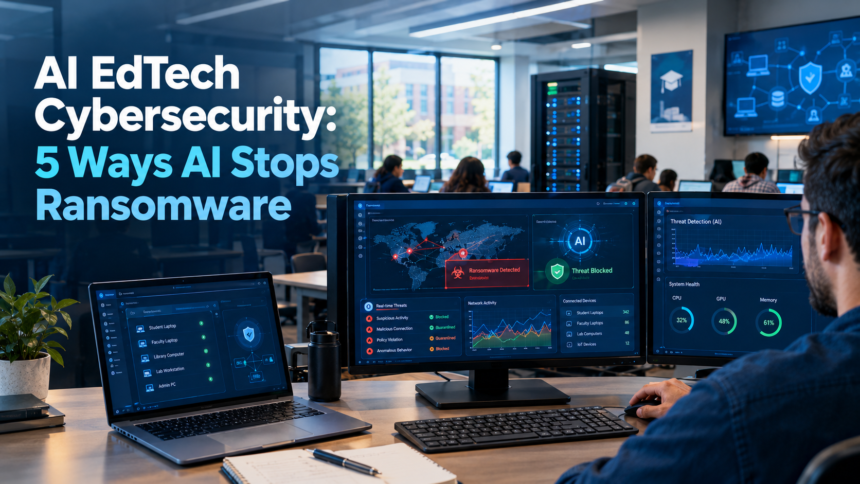
AI EdTech cybersecurity solutions are becoming increasingly important as schools and universities face growing ransomware and data-security risks. Educational institutions have rapidly expanded their use of cloud classrooms, online examinations, digital libraries and AI-assisted learning platforms, increasing both their capabilities and their attack surface. Modern AI-powered security systems can help organizations detect suspicious behavior earlier, reduce response times, protect sensitive student data and build more resilient learning environments.
Introduction
A few months ago, I discussed digital transformation with an IT administrator at a university. The institution had already invested heavily in cloud-based classrooms, online examinations, digital libraries, and AI-assisted learning platforms. On paper, everything appeared modern and secure.
Then someone asked a simple question.
If ransomware encrypted every student record tonight, how quickly could the university recover?
The room became unusually quiet. It was not because they lacked talented engineers. Quite the opposite. Their infrastructure had evolved rapidly over the previous few years, but their cybersecurity strategy had not evolved at the same pace. That conversation reminded me of something many organizations still overlook.
Digital transformation and cybersecurity are not the same thing.
Adding cloud platforms, mobile learning, AI-powered educational tools, and remote access certainly improves learning experiences. At the same time, however, every new digital service introduces another potential entry point for attackers.
Educational institutions now manage enormous volumes of highly sensitive information, including:
- Student identities
- Academic transcripts
- Financial aid records
- Examination databases
- Faculty credentials
- Medical accommodation records
- Research projects
- Parent contact information
For cybercriminals, this information represents an extremely valuable target.
Unlike many private companies, schools and universities often operate with limited cybersecurity budgets while supporting thousands—or sometimes hundreds of thousands—of users across campuses, remote classrooms, and personal devices.
This combination of valuable data and complex infrastructure has made education one of the fastest-growing sectors for ransomware attacks.
Fortunately, defensive technology is evolving as well.
Artificial intelligence is fundamentally changing how educational organizations identify cyber threats. Instead of relying only on known malware signatures, modern AI systems continuously analyze user behavior, network activity, device communication, and authentication patterns to identify suspicious actions long before ransomware begins encrypting files.
Rather than reacting after an attack succeeds, institutions can increasingly prevent attacks from escalating in the first place.
That shift—from reactive security to intelligent prediction—is perhaps the most important cybersecurity development education has seen in years.AI-powered security systems are becoming more capable as AI agents learn to analyze events, prioritize threats, and support automated responses across complex digital environments.
Why This Topic Matters in 2026
The cybersecurity landscape surrounding education has changed dramatically. Several independent technology trends are now converging at the same time.
Current Trends
- AI-powered learning platforms continue expanding.
- Hybrid and remote education remain common.
- Universities increasingly rely on cloud infrastructure.
- Student devices connect from thousands of different locations every day.
- Cybercriminals increasingly automate ransomware campaigns using AI-assisted techniques.
These changes have created tremendous educational opportunities. They have also dramatically expanded the attack surface.
The Problem
Traditional security tools primarily detect threats that have already been identified. Modern ransomware behaves differently. Attackers often spend days—or even weeks—inside a network before activating encryption. During that time, they quietly:
- Collect administrator credentials
- Explore network architecture
- Disable backup systems
- Identify valuable databases
- Move laterally between devices
By the time encryption begins, recovery becomes significantly more difficult. This explains why many institutions discover an attack only after serious damage has already occurred.
The Solution
Modern AI Ransomware Protection approaches cybersecurity differently. Instead of asking, “Have we seen this malware before?” AI asks, “Does this activity look abnormal?” Machine learning continuously builds a behavioral baseline for users, devices, applications, and network traffic.
When unusual behavior appears—such as unexpected file encryption, suspicious login activity, or abnormal data transfers—AI systems can immediately alert administrators or automatically isolate affected devices before widespread damage occurs. That ability to recognize behavioral anomalies rather than known malware signatures represents one of the biggest advances in educational cybersecurity today.
Prerequisites: Building a Strong Cybersecurity Foundation
Artificial intelligence is powerful. However, it performs best when supported by strong cybersecurity fundamentals. Before implementing advanced AI-based protection, educational institutions should already have several core security practices in place.
- Multi-Factor Authentication (MFA)
- Asset inventory and device management
- Endpoint protection
- Secure cloud configuration
- Regular software updates
- Reliable backup procedures
- Security awareness training
- Incident response planning
Think of AI as an intelligent security analyst rather than a magic solution. It enhances good security practices. It cannot replace them.
One mistake I frequently see is organizations purchasing advanced security platforms while neglecting basic cyber hygiene. In reality, the strongest cybersecurity strategies combine people, processes, and intelligent automation—not one instead of the others.
Step 1: How AI Threat Detection Systems Stop Ransomware Earlier
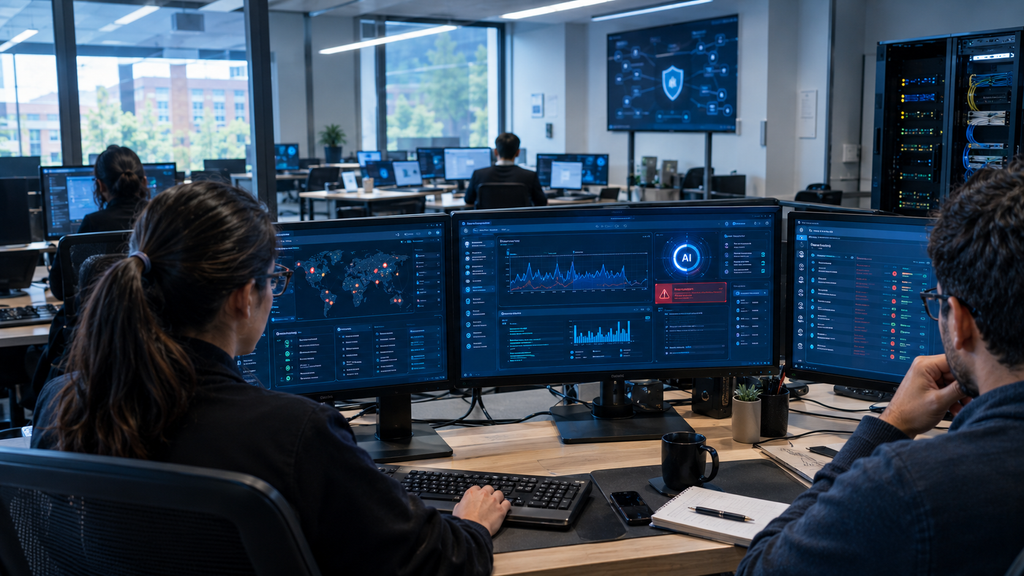
Traditional cybersecurity tools usually work like security guards checking visitor IDs. They compare files against databases of known malware signatures. If the malware is new—or slightly modified—the attack may go unnoticed.
Artificial intelligence approaches the problem differently. Instead of asking:
“Have I seen this virus before?”
It asks:
“Does this behavior look normal?”
That difference is surprisingly important.
Modern ransomware rarely launches immediately after entering a network. Sophisticated attackers often spend days quietly exploring systems before activating encryption.
During this reconnaissance phase, they might:
- Scan internal servers
- Collect administrator credentials
- Disable backup services
- Identify student databases
- Map cloud infrastructure
- Search research repositories
Individually, these activities may appear harmless. Together they create behavioral patterns that AI models recognize as increasingly suspicious. Machine learning continuously studies millions of events occurring across educational networks, including:
- Login frequency
- Device locations
- File access patterns
- Application usage
- Network communication
- Administrative privilege requests
When these behaviors suddenly change, AI immediately assigns a higher risk score. Rather than waiting for malware signatures, the platform reacts to behavioral anomalies. That time advantage often determines whether an organization experiences a minor incident—or a campus-wide crisis.
Why Behavioral Analysis Matters
Imagine a professor normally logs into the university network between 8:00 AM and 6:00 PM from New York.
Suddenly:
- The account logs in from another country.
- Downloads thousands of confidential student records.
- Accesses administrative databases it has never used before.
- Begins creating encrypted archive files.
Technically, every login credential is correct. Traditional systems may permit the activity. AI notices something much more important. The behavior itself is abnormal. Rather than assuming the user is legitimate, modern AI security platforms evaluate context continuously. This approach dramatically reduces the time attackers remain undetected.
Step 2: Zero Trust Network Education
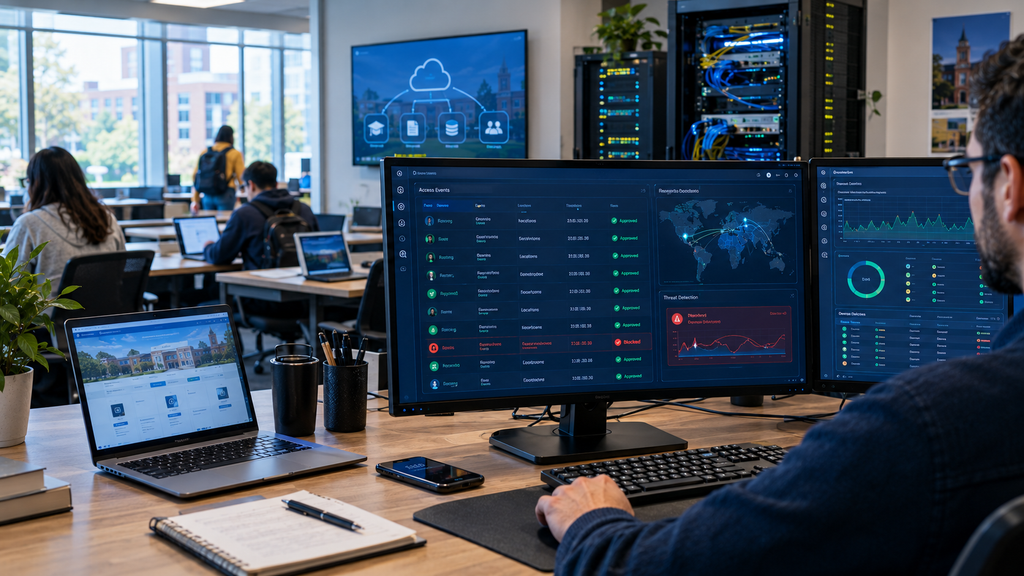
One cybersecurity principle has become increasingly influential during the last few years:
Never Trust. Always Verify.
This philosophy forms the foundation of Zero Trust Architecture. Traditional campus networks assumed that once users successfully logged in, they could generally move throughout the network with relatively little additional verification. That assumption no longer works.
Today’s educational environments include:
- Remote students
- Personal laptops
- Faculty smartphones
- Cloud classrooms
- Research laboratories
- IoT devices
- Smart classrooms
Every connected device potentially expands the attack surface. Zero Trust changes the security model completely. Instead of trusting users after login, every request is evaluated independently.
Questions include:
- Should this user access this file?
- Is this device healthy?
- Does the location match previous behavior?
- Is additional authentication required?
- Has the account behaved unusually today?
Artificial intelligence strengthens Zero Trust by answering these questions dynamically rather than relying only on fixed security rules.
In my experience, Zero Trust becomes significantly more effective when combined with behavioral AI because static policies cannot anticipate every modern attack technique.
Traditional Security vs AI-Powered Security
| Security Capability | Traditional Protection | AI-Powered Protection |
|---|---|---|
| Detection Method | Malware Signatures | Behavioral Analytics |
| Unknown Threat Detection | Limited | Excellent |
| Threat Response | Manual Investigation | Automated Response |
| Learning Capability | Static Rules | Continuous Learning |
| Insider Threat Detection | Difficult | Behavior-Based Detection |
| False Positive Reduction | Limited | Improves Over Time |
Step 3: AI Ransomware Protection in Cloud-Based Education
Cloud technology has transformed education. Students submit assignments online. Teachers conduct live virtual classes. Researchers collaborate globally. Administrative teams increasingly rely on cloud-based management systems. This flexibility offers enormous advantages. However, it also introduces new cybersecurity challenges.
Educational organizations must now secure:
- Cloud identities
- SaaS applications
- Student portals
- Research databases
- Faculty accounts
- API integrations
- Remote endpoints
Artificial intelligence provides visibility across these distributed environments. Instead of monitoring only on-campus servers, AI analyzes activity occurring throughout the entire educational ecosystem.
For example, AI can identify:
- Suspicious cloud login attempts
- Impossible travel authentication
- Large unauthorized downloads
- Privilege escalation
- Data exfiltration
- Abnormal API activity
Rather than treating cloud security separately from campus security, AI creates a unified view of organizational risk. That broader perspective significantly improves detection accuracy.
Machine Learning Malware Defense
Machine learning has changed malware detection in several important ways.
Traditional antivirus asks:
Does this file match a known malware signature?
Machine learning asks:
Does this software behave like ransomware?
Instead of comparing filenames, AI analyzes characteristics such as:
- File encryption speed
- Process relationships
- Memory behavior
- Registry modifications
- CPU utilization
- Network traffic
- User interaction patterns
Even when attackers modify ransomware code to bypass traditional detection, behavioral similarities often remain. This allows AI systems to identify threats that have never been seen before. Of course, no technology is perfect. Machine learning occasionally produces false positives. These developments are part of the broader evolution of AI technology, where increasingly capable models are being applied to real-world problems beyond content generation. Attackers continuously adapt their techniques. AI should therefore complement—not replace—experienced cybersecurity professionals.
The strongest educational security programs combine:
- Skilled IT teams
- Security awareness training
- Reliable backups
- Zero Trust Architecture
- Artificial Intelligence
- Continuous monitoring
No single technology solves cybersecurity by itself.
Step 4: Real-World Use Cases of AI in Educational Cybersecurity
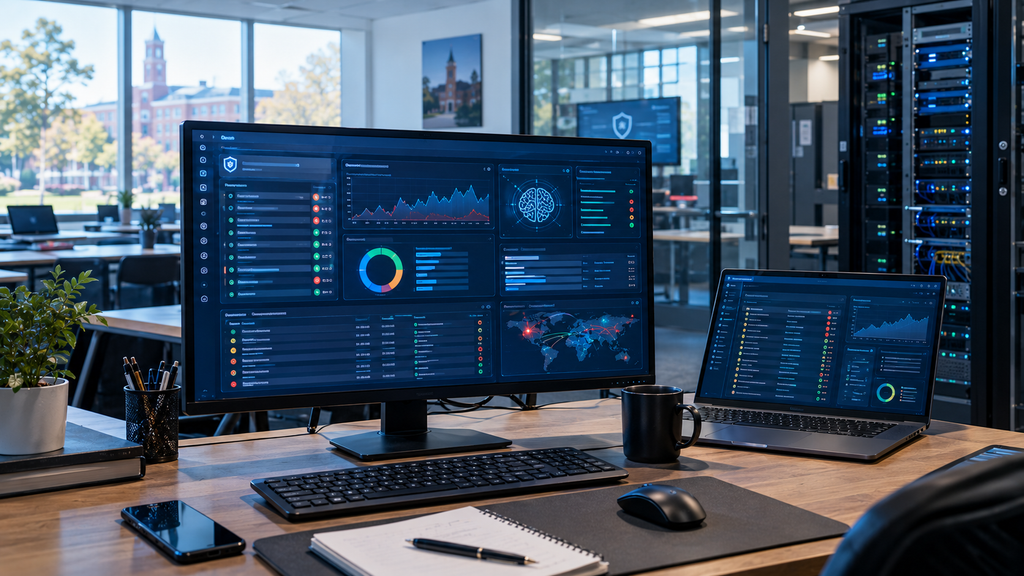
Artificial intelligence is no longer an experimental technology in education. Many institutions already rely on AI-assisted security platforms to improve threat visibility, reduce response time, and strengthen data protection. The value becomes much clearer when we examine realistic scenarios.
Use Case 1: Preventing a University-Wide Ransomware Outbreak
Imagine a university with approximately 35,000 students. At 2:15 AM, a faculty computer begins encrypting shared research files after an employee unknowingly opens a malicious email attachment. Without AI, the attack might spread silently for several hours.
An AI-driven monitoring platform notices something unusual almost immediately.
- Rapid file modifications
- Unusual CPU activity
- Unexpected encryption behavior
- Large numbers of file access requests
- Suspicious outbound network traffic
The platform automatically disconnects the infected device, revokes compromised credentials, alerts the security team, and preserves forensic evidence. What could have become a campus-wide ransomware incident is contained within minutes.
Use Case 2: Protecting Student Information
Educational institutions maintain enormous amounts of personally identifiable information (PII), including student names, examination records, financial information, scholarship records, and medical accommodations.
If an administrator account is compromised, AI immediately evaluates whether its behavior matches previous activity. If thousands of student records suddenly begin downloading from an unusual location, the AI platform can suspend access before significant data theft occurs.
Student Data Protection Compliance
Educational institutions increasingly face strict privacy and cybersecurity regulations.
Artificial intelligence supports compliance through:
- Continuous monitoring
- Automated audit logs
- Access tracking
- Threat detection
- Incident investigation
- Compliance reporting
Organizations with stronger visibility into user behavior generally respond faster during audits and cybersecurity incidents.
K–12 Data Breach Prevention
Primary and secondary schools often operate with smaller IT teams and tighter budgets. AI helps by automating repetitive security tasks such as:
- Phishing detection
- Student account monitoring
- Malware detection
- Classroom device monitoring
- Security alert prioritization
This allows IT staff to focus on higher-priority security incidents.
Human Security vs AI-Assisted Educational Security
| Feature | Traditional Human Monitoring | AI-Assisted Security |
|---|---|---|
| Threat Monitoring | Periodic | 24/7 Continuous |
| Detection Speed | Minutes or Hours | Seconds |
| Alert Prioritization | Manual | AI Risk Scoring |
| Cloud Visibility | Partial | Unified Monitoring |
| Scalability | Depends on Staff Size | Highly Scalable |
Common Cybersecurity Mistakes
- Assuming cloud platforms are automatically secure.
- Ignoring cybersecurity awareness training.
- Never testing backup recovery.
- Delaying operating system and software updates.
- Believing AI alone can replace experienced cybersecurity professionals.
Expert Recommendation
If I were advising an educational institution beginning its cybersecurity modernization today, I would recommend focusing on visibility before automation. Understand what devices exist, where sensitive data resides, who has access, and how users normally behave before deploying advanced AI automation.
Conclusion
Artificial intelligence has become one of the most valuable cybersecurity technologies available to schools and universities.
Although no technology guarantees perfect protection, AI significantly improves ransomware detection, reduces response times, strengthens student data protection, and enhances institutional resilience.
Educational organizations that combine Zero Trust Architecture, behavioral analytics, cloud security, regular employee training, and AI-powered monitoring will be significantly better prepared for the evolving cyber threats of 2026 and beyond.
Cybersecurity is no longer simply an IT responsibility. It has become a core requirement for protecting education itself.
References
- Cybersecurity and Infrastructure Security Agency (CISA)
- NIST Cybersecurity Framework
- Microsoft Security Documentation
- Google Cloud Security
- OpenAI Safety
Frequently Asked Questions
AI EdTech cybersecurity refers to using artificial intelligence and machine learning to protect educational technology platforms, student data, cloud classrooms, learning systems, and institutional networks from cyber threats such as ransomware, phishing, and unauthorized access.
AI EdTech cybersecurity can detect unusual user behavior, suspicious file activity, abnormal network traffic, and unexpected encryption patterns. This allows security teams to identify and isolate potential ransomware attacks before they spread across an educational network.
Yes. AI EdTech cybersecurity can continuously monitor access to sensitive student information, detect unusual downloads or login behavior, and alert security teams when activity appears suspicious. It can therefore add another layer of protection around student records and other sensitive data.
AI improves educational cybersecurity by analyzing large volumes of security events and identifying behavioral anomalies that traditional rule-based systems may miss. AI EdTech cybersecurity can also help prioritize alerts and automate certain responses, allowing security teams to investigate serious threats faster.
No. AI EdTech cybersecurity should complement, not replace, fundamental security practices such as multi-factor authentication, Zero Trust principles, software updates, endpoint protection, employee training, and tested backups. A layered security strategy provides stronger protection than relying on AI alone.


