




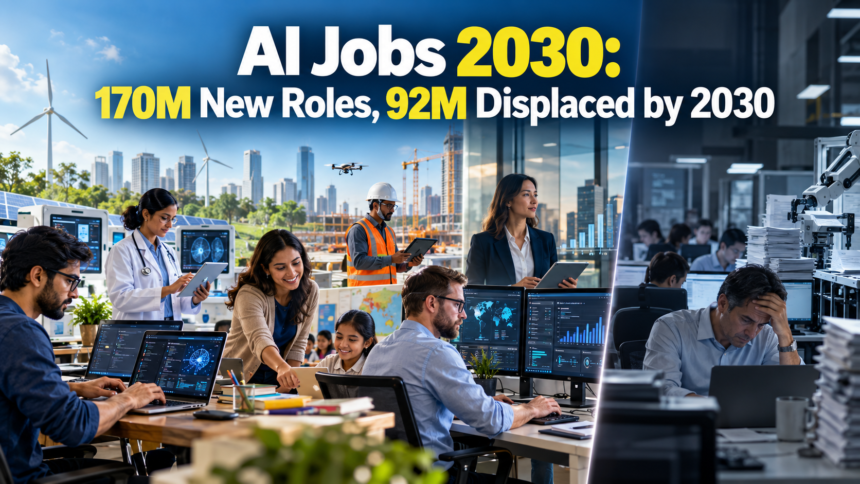
AI jobs 2030 are expected to grow as artificial intelligence, automation and wider economic shifts reshape the global labour market. The World Economic Forum projects 170 million jobs will be created and 92 million displaced by 2030, resulting in a net gain of 78 million jobs. AI is a major driver of this transformation—but it is only one part of a much broader change in how work is organized and performed.
The global labour market could add 170 million jobs by 2030 while 92 million existing roles are displaced, according to the World Economic Forum’s Future of Jobs Report 2025. The resulting net gain—78 million jobs—complicates a popular narrative that artificial intelligence will simply eliminate human employment.
The numbers require an important qualification. The WEF does not say AI alone will create all 170 million jobs. Its projections reflect a combination of technological change, demographic shifts, geoeconomic fragmentation, economic uncertainty, and the green transition.
That distinction matters for anyone trying to understand AI jobs in 2030. Technology occupations are among the fastest-growing roles in percentage terms, but some of the largest increases in absolute employment are expected in familiar fields such as agriculture, delivery, construction, care and education.
The central issue, then, is less whether work will survive AI than which work will grow, which tasks will be automated, and whether workers can acquire the skills demanded by the transition.
170 Million Created, 92 Million Displaced: What the Numbers Actually Mean
The World Economic Forum published the Future of Jobs Report 2025 in January 2025. Its analysis draws on perspectives from more than 1,000 employers representing over 14 million workers across 22 industry clusters and 55 economies.
| Labour-market measure through 2030 | WEF projection |
|---|---|
| New jobs created | 170 million |
| Existing jobs displaced | 92 million |
| Net employment increase | 78 million |
| Structural labour-market churn | 22% |
| Net employment increase | 7% |
The 170 million projected new roles are roughly 14% of current employment in the analysis, while the 92 million displaced positions represent about 8%. Together, they amount to substantial movement within a dataset covering roughly 1.2 billion formal jobs.
These are projections, not a guaranteed count of future vacancies. They are based on employer expectations and the report’s methodology for assessing how macroeconomic and technological forces may affect employment between 2025 and 2030.
Key clarification: The 170 million figure should not be described as “170 million AI jobs.” AI is an important driver within a larger set of forces reshaping employment.
AI Is Driving Some of the Fastest-Growing Careers
If the 170 million figure should not be described as “170 million AI jobs,” that does not make artificial intelligence a minor factor.
Among jobs ranked by percentage growth, the WEF places Big Data Specialists first, followed by FinTech Engineers and AI and Machine Learning Specialists. Software and Applications Developers are also among the fastest-growing professions.
The report found that 86% of surveyed employers expect AI and information-processing technologies to transform their businesses by 2030.
This is where the future AI job market becomes more nuanced than a list of new job titles.
Organizations do not need only people building artificial-intelligence models. They also need workers who can deploy technology, integrate it into existing operations, secure digital infrastructure, and combine technical capabilities with industry-specific knowledge.

The supplied source transcript describes this broader idea as the rise of the “hybrid professional”: someone who combines an established discipline—such as development, design or marketing—with newer AI and automation capabilities.
The phrase is useful as an explanatory concept, although it should not be confused with a formal WEF occupational category.
The underlying labour-market direction, however, is consistent with the WEF findings: technical proficiency and established human capabilities are increasingly expected to work together rather than operate as separate career tracks.
The Biggest Job Gains Will Not All Be in Technology
A fixation on AI careers can obscure another important finding.
When occupations are measured by absolute numbers of additional jobs rather than percentage growth, many of the strongest areas are not futuristic technology positions.
Farmworkers rank first in the WEF’s projection of occupations adding the largest number of jobs. Delivery drivers, software developers, building construction workers and shop salespersons are also among the leading occupations by absolute growth.
Care and education are important as well. The WEF expects nursing professionals, social workers and counselling professionals to benefit from demographic changes, while education occupations are projected to grow as demographic patterns alter labour demand in different parts of the world.
This is one reason the “AI versus humans” framing can be misleading.
The employment landscape of 2030 is being influenced simultaneously by technology, ageing populations in some economies, expanding working-age populations in others, energy transition, economic pressures and geopolitical change.
AI may reshape how a nurse, teacher, engineer or salesperson works without eliminating the underlying occupation.
Green-Energy Jobs Form Another Growth Corridor
The green transition is another major source of employment change.
Environmental Engineers, Renewable Energy Engineers and specialists in autonomous and electric vehicles appear among the WEF’s fastest-growing occupations. Sustainability Specialists and Renewable Energy Technicians are also expected to benefit from climate and energy investment.
The Forum estimates climate-change adaptation could contribute an additional 5 million net jobs by 2030, while climate-change mitigation could contribute another 3 million. Changes in energy generation, storage and distribution are projected to contribute another 1 million net positions.
For workers planning a career around future demand, that suggests the technology story extends beyond generative AI.
Energy systems, environmental engineering and sustainability are part of the same wider restructuring.
Some Roles Face Greater Automation Pressure
Job creation is only one side of the forecast.
The WEF also expects substantial decline in particular occupations.
Cashiers and ticket clerks, administrative assistants and executive secretaries are among roles expected to decline rapidly. Graphic designers have also entered the group of faster-declining occupations, which the Forum links partly to generative AI’s increasing ability to perform knowledge-work tasks.
The supplied transcript goes further, arguing that data entry, routine administration, basic customer support, basic content writing and basic design face heavy automation pressure.
Those claims require care.
The WEF evidence supports declining demand for several clerical and administrative occupations and identifies graphic design as an occupation facing new pressure. It does not establish that every customer-support, content-writing, or design position will disappear, nor does it justify declaring an entire profession obsolete.
Automation generally affects tasks as well as jobs. The outcome can involve elimination, redesign, productivity gains, reassignment, or the creation of different responsibilities.
That uncertainty is particularly important when giving career advice.
AI Skills Are Rising Fast—but Human Skills Remain Critical

Perhaps the most actionable part of the report concerns skills.
Employers expect 39% of workers’ key skills to change by 2030. AI and big data lead the WEF ranking of fastest-growing skills, followed by networks, cybersecurity and technological literacy.
But the list quickly moves beyond technology.
Creative thinking is rising in importance. So are resilience, flexibility and agility; curiosity and lifelong learning; leadership and social influence; talent management; analytical thinking; and environmental stewardship.
That combination undermines another simplistic assumption: that workers can future-proof themselves merely by learning how to operate the newest AI tool.
The labour market appears to be rewarding a combination of technical and human capability.
Someone who understands AI but cannot reason critically, communicate, collaborate or adapt may still be poorly equipped for a changing organization. Conversely, a strong domain specialist who refuses to engage with increasingly important technology could also face a disadvantage.
For students and career changers, the implication is practical: developing AI literacy alongside an existing professional discipline may offer more resilience than chasing a fashionable job title in isolation.
Reskilling May Be the Hardest Part of the Transition
The size of the skills transition presents a problem of its own.
The WEF says 63% of employers identify skills gaps as a major barrier to business transformation. If the global workforce were represented by 100 people, the Forum estimates that 59 would require reskilling or upskilling by 2030. Eleven of those 59 may not receive the training they need.
Employer plans show both sides of AI adoption.
According to the report, 77% of employers plan to upskill workers in response to AI-related change, while 41% expect to reduce parts of their workforce where AI can automate tasks. Almost half expect to move employees exposed to AI disruption into other areas of their organizations.
This makes reskilling more than an individual career decision.
Companies, universities, training providers and governments all influence whether workers can move from declining occupations into expanding ones.
A net increase of 78 million jobs does not mean that the 92 million people associated with displaced roles will automatically move into those new positions. The skills, geography, qualifications and experience demanded by growing occupations may be different.
A job created in renewable-energy engineering, for example, does little by itself for an administrative worker whose role has been automated unless a realistic path to new employment exists.
That mismatch is one of the central risks behind otherwise positive headline numbers.
What AI Jobs 2030 Means for Students and Professionals

For workers making decisions now, the WEF findings support several directions without providing a guaranteed career formula.
Technical skills deserve serious attention. AI and big data, cybersecurity, and broader technological literacy sit at the top of employers’ expected skill-growth rankings. Software development, machine learning, data-oriented work, and security-related roles are therefore supported by a measurable demand signal.
But specialization should be considered alongside domain expertise.
A marketer who understands AI-enabled workflows, a developer who can work with machine-learning systems, a financial professional comfortable with data tools, or an engineer who understands automation may be positioned differently from someone whose capabilities remain confined to repetitive tasks.
At the same time, the evidence does not support abandoning non-technical careers.
Healthcare, education, agriculture, construction and other core-economy occupations account for substantial projected employment growth.
The more defensible career strategy is therefore not “learn AI or lose your job.”
It is to understand how technology is changing the work you want to do, identify which parts are becoming more valuable or more automatable, and build a combination of skills that remains useful as the occupation evolves.
Why It Matters
The 170 million figure is encouraging only when read alongside the 92 million figure.
Together, they describe a labour market undergoing significant reallocation rather than a future in which technology produces effortless employment growth.
For businesses, the challenge is finding and developing workers with the right skills. For governments and educational institutions, it is creating credible routes from vulnerable work into expanding sectors. For individuals, the immediate issue is whether the capabilities they are developing correspond with where employers expect demand to move.
The WEF data also offer a useful counterweight to two competing extremes.
One says AI will destroy employment.
The other says AI will create an enormous new economy in which everyone benefits.
Neither is what the report projects.
Its outlook is simultaneously disruptive and net-positive: 170 million roles created, 92 million displaced, and 78 million more jobs overall—if the underlying projections materialize.
What Happens Next
The WEF forecast covers the period through 2030, so the numbers should be evaluated as a direction of travel rather than a completed outcome.
AI adoption will continue to interact with economic growth, demographics, regulation, energy investment, geopolitical developments, and employer decisions. The speed of technological change could also alter which individual tasks companies automate and which new capabilities become valuable.
What is clearer from the employer survey is that standing still carries its own risk.
The future workforce is likely to require stronger technological capability and durable human skills. The challenge through 2030 will be converting that demand into training, mobility and employment opportunities accessible to the people whose jobs are changing.
The future of work, in other words, is not adequately described as a contest between AI and people.
It is a transition in what people do, what machines do, and which combinations of the two employers are willing to pay for.
Source Notes
- World Economic Forum — Future of Jobs Report 2025
- World Economic Forum — Jobs Outlook
- World Economic Forum — Skills Outlook
- Supplied Bengali transcript: “170 Million New Jobs in the Age of AI — Which Side Will You Be On?” used as supporting editorial context; quantitative claims should be read against the original WEF research.
Frequently Asked Questions
AI jobs 2030 are likely to include roles in artificial intelligence, machine learning, big data, software development, cybersecurity, and AI-enabled business operations. However, the job market will also create opportunities outside technology as AI changes how traditional professions are performed.
According to the World Economic Forum’s Future of Jobs Report 2025, employers expect 170 million jobs to be created and 92 million jobs to be displaced globally by 2030, resulting in a projected net increase of 78 million jobs. These figures reflect multiple economic and technological forces, not AI alone.
AI and big data, networks and cybersecurity, and technological literacy are among the fastest-growing skills. Human capabilities such as analytical thinking, creative thinking, resilience, adaptability, leadership, and lifelong learning are also expected to remain highly valuable.
AI is more likely to automate specific tasks and reshape jobs than eliminate all human employment. The article’s evidence suggests that some routine roles face greater pressure, while growing demand is expected in technology, healthcare, education, construction, agriculture, and other sectors.
Students can build AI literacy alongside a strong professional discipline. Learning areas such as AI and data, cybersecurity, software development, or automation can be combined with communication, critical thinking, creativity, and adaptability to remain useful as jobs evolve.


