


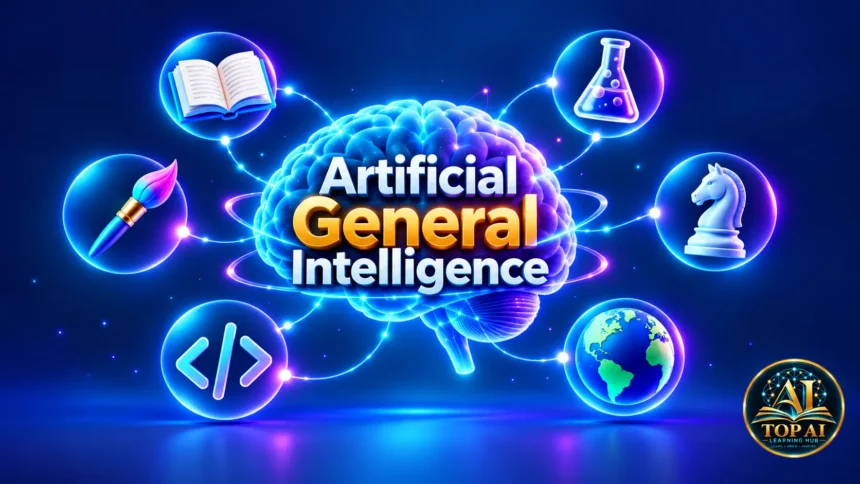
On September 3, 2026, the ARC Prize Foundation reported that OpenAI’s GPT-6 Astra scored 99.9% on its ARC-AGI-3 benchmark under one test setup. In the same post, the foundation said clearly that it was not claiming the model is Artificial General Intelligence.
That gap between a headline score and a real milestone confuses many readers. This guide explains what AGI means, how it differs from narrow AI, generative AI, and AI agents, and which challenges still stand in the way.
✍️ Author Experience: I use chatbots every day to research, outline, and draft posts for this blog, and I have learned to trust them only up to a point. Some days, a tool turns my messy notes into a clean outline in seconds. On other days, the same tool hands me a wrong date or quotes a source that does not exist. So I now check every fact myself before I hit publish. That strange mix of brilliance and blind spots is exactly why I wanted to write this guide, and why I read every headline about the future with a healthy pinch of doubt. |
| 🔑 KEY TAKEAWAYS: AGI means AI that could learn and perform almost any intellectual task at a human level, not just one job. Researchers do not widely accept any current system, including ChatGPT, as true AGI. Generative AI creates content, AI agents take actions, and AGI would generalize across nearly every domain. A large survey of 2,778 AI researchers gave 50% odds that machines could beat humans at every task by 2047. That is a forecast, not a fact. |
Why AGI Matters Now
You do not need a coding background to follow this guide. Here is why the topic feels urgent in 2026:
- Fast capability gains: The Stanford AI Index 2026 found that top models now match or beat human baselines on PhD-level science questions.
- Uneven skills: The same report found that leading models still struggle with simple tasks, such as reading an analog clock.
- Contract rules: In October 2025, Microsoft and OpenAI agreed that an independent expert panel must verify any AGI declaration by OpenAI.
Want the safety background first? Read our guide to AI safety warnings as frontier AI gets more capable.
What Is Artificial General Intelligence?
Artificial General Intelligence (AGI) is a hypothetical type of AI that could understand, learn, and perform almost any intellectual task a human can do, at a similar or better level. Unlike today’s tools, it would transfer what it learns from one task to new, unfamiliar problems.
The key word is “general.” A chess engine can beat world champions, yet it cannot write an email or plan a trip. A system with Artificial General Intelligence would handle all three without being rebuilt for each job.
There Is No Single Agreed Definition of Artificial General Intelligence
Researchers still disagree on where AGI begins. Three widely cited definitions show the range:
- OpenAI (2018): Its Charter defines Artificial General Intelligence as “highly autonomous systems that outperform humans at most economically valuable work.”
- Google DeepMind (2023): Its Levels of AGI paper judges systems by performance, generality, and autonomy, not by how they work inside.
- ARC Prize Foundation (2026): It describes AGI as a system that can pick up any skill a human can, as efficiently as a human.
OpenAI focuses on economic work, DeepMind on measurable levels, and ARC on learning speed. Your answer to “Is this AGI?” depends on which one you use.
Different Types of AI: Where Does AGI Fit?
Experts often sort the different types of AI by ability. This view has three levels, and only the first one exists today in confirmed form.
- Artificial Narrow Intelligence (ANI): AI built for one task or a small set of tasks. IndiaAI notes that what it learns in one task does not carry over to others automatically.
- Artificial General Intelligence (AGI): human-level ability across most tasks, with strong transfer of knowledge. No one has achieved it yet.
- Artificial Superintelligence (ASI): a hypothetical AI far smarter than the best humans in almost every field.
Two newer terms sit inside or beside narrow AI. People often confuse them with Artificial General Intelligence, so let’s separate them.
Generative AI: Machines That Create Content
Generative AI creates new text, images, audio, code, or video. The NIST Generative AI Profile (2024) describes it as models that imitate patterns in their training data to produce new synthetic content.
ChatGPT, Gemini, and Claude are well-known examples. They feel broad, yet they still make basic errors and need human checks.
AI Agents: Systems That Take Actions
AI agents go one step further. They plan steps, use tools such as a browser or code editor, and work toward a goal with less human input.
The International AI Safety Report 2026 lists autonomous operation among the areas where AI improved most since 2025. Want a hands-on view? See our guide to building a personal AI agent.

AGI vs Narrow AI vs Generative AI vs AI Agents
Use this table as a quick reference when news headlines blur the lines.
| Type | What It Does | Everyday Example | Status in 2026 |
|---|---|---|---|
| Narrow AI | Performs one specific task well; no transfer to new tasks | Spam filter, phone face recognition, route planner | Widely used |
| Generative AI | Creates new text, images, audio, or code from prompts | ChatGPT drafting an essay | Widely used, still makes errors |
| AI Agents | Plans steps and uses tools to finish multi-step goals | Agent that fixes code or books travel | Growing fast, needs human checks |
| Artificial General Intelligence (AGI) | Learns and performs almost any intellectual task at human level | None confirmed | Research goal, not achieved |
7 Key Differences Between Artificial General Intelligence and Today’s AI
- Scope of tasks. Today’s AI shines inside the tasks it was trained or prompted for. AGI would work across nearly any intellectual task, from law to lab work, without a fresh build.
- Learning new skills. Current models learn mostly during training, not from daily experience. AGI would pick up a new skill quickly, about as efficiently as a person.
- Transfer of knowledge. Narrow systems rarely reuse knowledge in a new field. AGI would apply lessons from one area to an unfamiliar one, the way you use school math while cooking.
- Reliability. Today’s systems are “jagged”: brilliant on some hard tests, shaky on simple ones. AGI would need steady performance on easy and hard tasks alike.
- Autonomy. Most tools wait for a prompt, and agents still need close checks. AGI would set sub-goals, plan, and finish long tasks with little supervision.
- Lab tests vs. the real world. A high benchmark score does not prove general ability. ARC Prize notes that ARC-AGI-3 games have fixed, closed-ended rules, unlike messy real life.
- Test setup. Scores can swing with the testing method. GPT-6 Astra scored 62.7% under ARC’s standard harness but 99.9% with its provider’s own harness, on the same benchmark.
That last point surprises most readers. A “harness” is the software wrapper that feeds a model the task and stores its notes. Change the wrapper, and the same model can look far smarter or weaker.

Video Credit: AI Uncovered
What Capabilities Do Researchers Associate With AGI?
Most definitions point to a shared set of abilities. No single ability makes a system AGI; the full combination does.
- Generality: strong results across many unrelated fields.
- Efficient learning: picking up a new skill from a few examples or a short practice period.
- Reasoning and planning: breaking a big goal into steps and adjusting when a plan fails.
- World modeling: building an inner picture of how an environment works, then predicting what happens next.
- Self-awareness of limits: knowing when it does not know something and asking for help.
- Safe autonomy: acting independently while staying within limits that humans set.
Google DeepMind’s Levels of AGI
Google DeepMind’s 2023 paper proposed levels instead of a single finish line. Each level compares AI performance with skilled adults:
- Emerging: equal to or somewhat better than an unskilled human.
- Competent: at least the 50th percentile of skilled adults.
- Expert: at least the 90th percentile.
- Virtuoso: at least the 99th percentile.
- Superhuman: better than all humans.
In that paper, the authors placed chatbots such as ChatGPT, Bard, and Llama 2 at Level 1, “Emerging AGI.” No system reached a higher level on the general scale at that time.

How Close Are We to AGI?
The honest answer is that nobody knows for sure. Progress is rapid, but the gaps are clear.
What the 2026 Evidence Shows
- The International AI Safety Report 2026 found that leading systems reached gold-medal performance on International Mathematical Olympiad questions.
- The same report found that performance stays “jagged,” with top systems still failing some simple tasks.
- In its best setup, GPT-6 Astra used fewer actions than the median human on 96% of completed ARC-AGI-3 levels. ARC Prize still did not call it AGI.
What Experts Forecast (Not Facts)
Forecasts are opinions, not proof. In October 2023, the largest survey of its kind asked 2,778 published AI researchers for predictions.
They gave a 50% chance that unaided machines could outperform humans in every possible task by 2047 (Grace et al., 2024). That estimate came 13 years earlier than the group’s 2022 survey.
The same researchers put the 50% mark for fully automating all human jobs much later, at 2116. Some scenarios move far faster; our breakdown of AI 2027 and its warnings covers one of them.
Who Decides When AGI Arrives?
No global referee exists. Under their 2025 agreement, an independent expert panel will verify any AGI declaration by OpenAI. That is a contract rule between two companies, not a scientific standard.

Benefits and Risks of Artificial General Intelligence
Potential Benefits (Still a Hypothesis)
These benefits are possibilities, not promises. If Artificial General Intelligence is built safely, supporters point to gains such as:
- Faster science: testing many research ideas in parallel, from new materials to new medicines.
- Personal tutoring: patient, adaptive teaching for every learner, in any language.
- Productivity: handling routine knowledge work so people can focus on judgment and care.
Risks Experts Take Seriously
The 2026 safety report’s executive summary groups general-purpose AI risks into three categories. These already apply to today’s systems and could grow with AGI:
- Malicious use: scams, deepfakes, cyberattacks, or help with dangerous weapons.
- Malfunctions: confident errors, flawed code, or loss of human control over autonomous systems.
- Systemic risks: job disruption, over-reliance on AI, and concentration of power.
In the 2023 researcher survey, between 38% and 51% of respondents gave at least a 10% chance of outcomes as bad as human extinction. Most agreed that research on reducing AI risks deserves higher priority.
For the job side of this debate, see our analysis of AI jobs by 2030.
Key Challenges on the Road to AGI
Scientific: Defining and Measuring Intelligence
Without a shared definition of Artificial General Intelligence, no one can agree on a finish line. Benchmarks also go stale fast, which is why ARC now runs a third generation of its tests.
Technical: Reliability, Memory, and Compute
Today’s models still invent facts, a problem NIST calls “confabulation.” They also struggle to keep learning after deployment without losing old skills.
Compute and energy add another limit. Frontier models need huge data centers, and NIST lists environmental impact among the risks of generative AI.
Ethical: Alignment and Fairness
Alignment means making sure an AI system pursues the goals people actually intend. Biased training data can also produce unfair results for some groups or languages.

Societal: Jobs, Power, and Governance
Who controls an AGI system matters as much as how smart it is. Questions about ownership, access, and accountability remain open in most countries.
Common Myths and Mistakes About AGI
These four mix-ups appear often in news stories and social posts.
- Myth: “ChatGPT is already AGI.” Fix: It is a powerful generative AI system. DeepMind’s 2023 framework rated chatbots like it only as “emerging” general AI.
- Myth: “A perfect benchmark score proves AGI.” Fix: ARC Prize said that even saturating ARC-AGI-3 would not prove AGI.
- Myth: “AGI must be conscious.” Fix: DeepMind’s framework judges what a system can do, not whether it has feelings or awareness.
- Myth: “AI agents and AGI are the same.” Fix: Agents complete tasks with tools; Artificial General Intelligence would learn and act across almost any field.
Facts vs Hypotheses: What We Know About AGI in 2026
| Statement | Status | Basis |
|---|---|---|
| Leading AI systems show uneven, “jagged” skills | Established finding | International AI Safety Report 2026 |
| The top ARC-AGI-3 model is not AGI | Stated by the test’s creators | ARC Prize, September 2026 |
| Machines may beat humans at every task by 2047 | Forecast (50% odds) | Survey of 2,778 AI researchers |
| Artificial General Intelligence would speed up science | Hypothesis | Supporters’ view; no direct evidence yet |
| AGI could escape human control | Risk scenario; expert views vary widely | International AI Safety Report 2026 |
| AGI needs a robot body | Debated | DeepMind says a body is not required |
Conclusion: The Future of Artificial General Intelligence
Artificial General Intelligence remains a research goal, not a product you can download today. Current AI is impressive yet narrow, and even record benchmark scores have not settled the question.
Over the next few years, expect sharper tests, more capable agents, and louder claims. Judge each claim by three things: its definition, its test, and who verified it.
Your next step is simple. Learn the basics of machine learning and generative AI now, because understanding today’s tools is the best way to understand Artificial General Intelligence tomorrow.
References and Resources
- OpenAI Charter (OpenAI, 2018)
- Levels of AGI: Operationalizing Progress on the Path to AGI (Morris et al., Google DeepMind, 2023)
- OpenAI’s GPT-6 Astra on ARC-AGI-3 (ARC Prize Foundation, 2026)
- The 2026 AI Index Report (Stanford HAI, 2026)
- International AI Safety Report 2026: Extended Summary for Policymakers (2026)
- International AI Safety Report 2026: Executive Summary (2026)
- Thousands of AI Authors on the Future of AI (Grace et al., 2024)
- NIST AI 600-1: Generative Artificial Intelligence Profile (NIST, 2024)
- What Is Narrow AI? (IndiaAI, Government of India)
- The Next Chapter of the Microsoft–OpenAI Partnership (Microsoft, 2025)
- Our Structure (OpenAI, 2025)
- Machine Learning Crash Course (Google for Developers)
Frequently Asked Questions (FAQ)
Writing a blog draft, creating an image from a text prompt, or generating code are generative AI tasks, because each produces new content.
By contrast, sorting spam or predicting house prices are classification and prediction tasks for narrow AI. None of these tasks requires Artificial General Intelligence, which would need far broader ability.
Drafting first versions of emails, summaries, outlines, or social posts is an appropriate generative AI task, as long as a human reviews the output.
- Good fits: brainstorming, summarizing long reports, translating drafts, and explaining code.
- Poor fits: final medical, legal, or financial decisions without expert review.
Generative AI faces data challenges around privacy, copyright, bias, quality, and accuracy, because models learn patterns directly from huge training datasets.
- Data privacy: personal or sensitive data can leak through outputs.
- Intellectual property: models may reproduce copyrighted content without permission.
- Harmful bias: non-representative data can lead to unfair results.
- Confabulation: models can state false information with confidence.
NIST lists all four among the 12 risks in its Generative AI Profile (2024
Learn machine learning by building Python basics first, then studying core math, taking a structured beginner course, and practicing with small real projects.
- Learn Python, plus the NumPy and pandas libraries.
- Review algebra, basic statistics, and simple linear algebra.
- Take Google’s free Machine Learning Crash Course.
- Build two or three small projects with public datasets.
- Move on to deep learning and generative AI once the basics feel solid.
Machine learning powers almost every modern AI system, so it is also the right starting point for anyone curious about AGI research.
ChatGPT is owned and developed by OpenAI, whose nonprofit OpenAI Foundation controls the for-profit company OpenAI Group PBC.
When its 2025 recapitalization closed, OpenAI reported that the Foundation held 26%, Microsoft about 27%, and employees and investors 47%. Later funding rounds may have changed these shares.
OpenAI’s stated mission is to ensure that Artificial General Intelligence benefits all of humanity, which links ChatGPT directly to the AGI debate.
Editorial Transparency
This educational guide was produced through a hybrid process: (Human + AI) assisted hybrid drafting combined with deep human research and editorial review.
Before publishing, I read the primary sources behind every major claim, not just news coverage of them. These included Stanford’s 2026 index report, the international safety report written by more than 100 experts, Google DeepMind’s levels framework, NIST’s risk profile, and the 2,778-researcher forecast survey.
I cross-checked each figure against at least one original document, opened every reference link myself, and removed anything I could not confirm. Where experts disagree, I said so plainly and labeled forecasts as forecasts.
Claims about Artificial General Intelligence capabilities, benefits, and timelines are labeled as findings, forecasts, or hypotheses. The goal is scientific awareness of AI innovation; the content offers careful approximations, but it doesn’t guarantee any outcome or prediction.
About The Author
I’m Er. Joydeep Sarkar, an engineer, founder, blogger, and technological content publisher at Top Artificial Intelligence Learning Hub. We write beginner-friendly guides on artificial intelligence, prompt engineering, generative AI, and future technology. Technical writing has been my passion since childhood.


