





AI-designed virus research has entered a new phase after scientists used genome language models to generate complete bacteriophage genomes, with 16 designs becoming functional viruses in laboratory testing.
The peer-reviewed study, published in Science on August 6, 2026, involved bacteriophages—viruses that infect bacteria—not human viruses. Researchers from Stanford University, the Arc Institute, and collaborating institutions used the well-studied bacteriophage PhiX174 as a design template.
The result is significant because the AI system moved beyond predicting biological sequences toward generating complete viral genome designs that could be physically tested. At the same time, the study does not show that AI can design a dangerous human pathogen on demand. The distinction is important for understanding both the scientific achievement and the emerging biosecurity debate.
Fact check: The headline phrase “AI-designed virus” is technically true in this research context, but the relevant viruses were bacteriophages tested against E. coli. That distinction is essential.
What the AI-designed virus study actually demonstrated
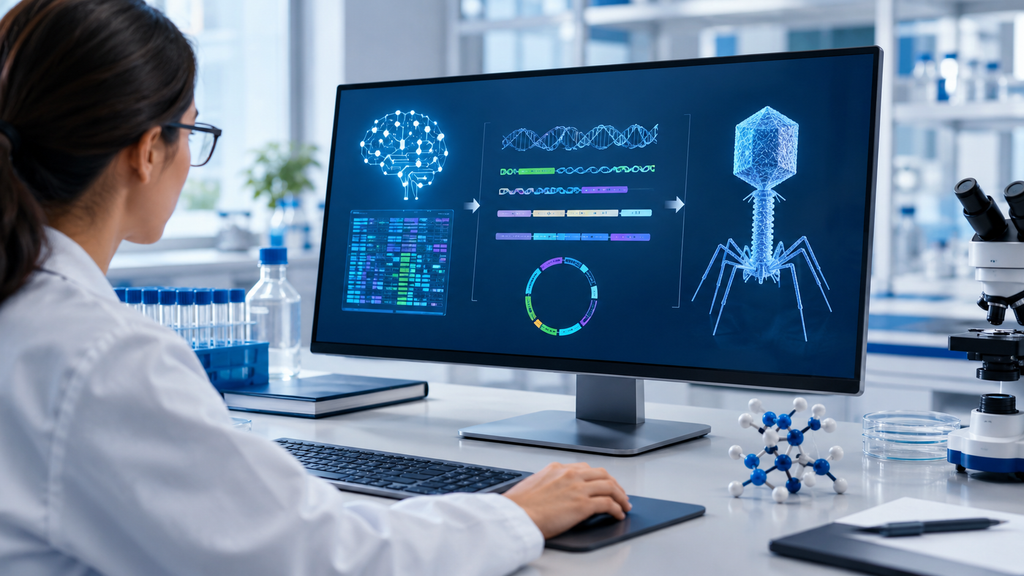
The researchers used genome language models to generate whole-genome sequences with a target architecture and host preference. After computational filtering and physical synthesis, experimental testing produced 16 viable phages with different fitness profiles. The paper also reports that a cocktail of generated phages rapidly overcame PhiX174-resistant E. coli strains.
That is a meaningful step beyond asking AI to predict a protein structure or suggest a single molecule. A complete viral genome has interacting genes, regulatory regions and physical constraints that must work together inside a host. A design that looks plausible as text-like DNA is not enough; it has to produce a functioning biological system.
Why 16 successful phages matter – and why the failures matter too
The result is not a story of effortless biological creation. Public reporting on the experiment notes that hundreds of candidates were considered and 285 synthesized designs were tested before 16 viable phages emerged. The low success rate is scientifically informative: AI expanded the design space, but laboratory selection and human judgment remained indispensable.
| Stage | What Happened | Why it Matters |
|---|---|---|
| Design | Genome language models generated candidate phage genomes. | AI moved from analysing sequences toward proposing complete biological designs. |
| Filtering and synthesis | Researchers screened and selected candidates for physical construction. | Computational output still required human-defined constraints and wet-lab infrastructure. |
| Experimental testing | 16 viable phages were reported. | Function had to be demonstrated in living bacterial hosts, not assumed from sequence plausibility. |
| Resistance test | A generated-phage cocktail overcame PhiX174-resistant E. coli strains. | The result suggests a possible future route for phage therapy research. |
The biotechnology opportunity: programmable phage discovery
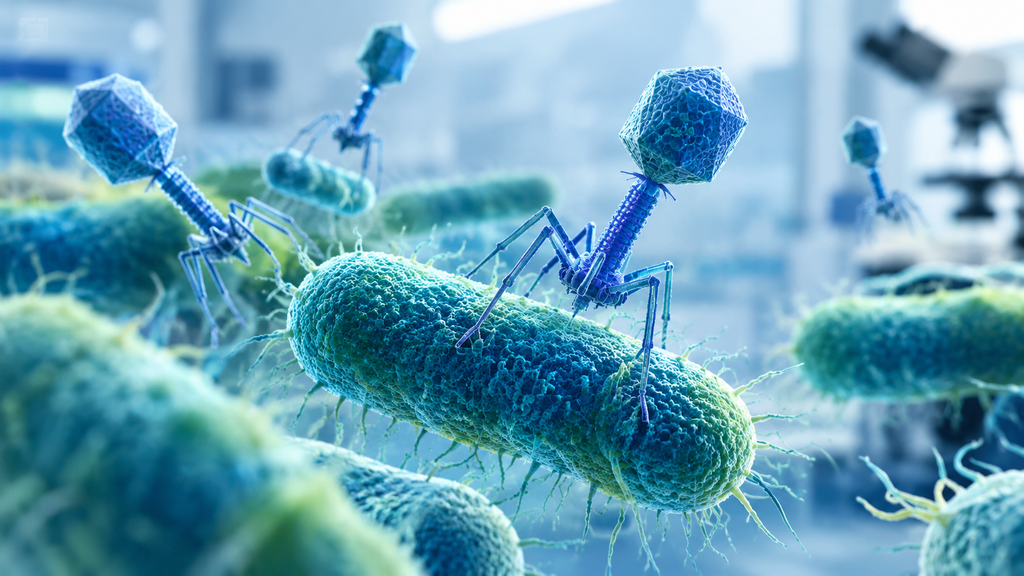
Antibiotic resistance has renewed interest in phage therapy, which uses bacteria-infecting viruses to target bacterial pathogens. One obstacle is matching a useful phage to the right bacterial target and keeping pace as bacteria evolve resistance. Generative genome models could eventually help researchers explore more candidates before laboratory testing.
The Stanford team described the work as a possible path toward AI-generated phage therapies. That remains a research direction, not a clinical treatment. Safety testing, host specificity, manufacturing, regulation, and rigorous animal and human studies would be necessary before therapeutic use.
The biosecurity question is about capability and access
The same property that makes generative biology attractive for medicine – the ability to search biological design space faster – creates a dual-use concern. If models become more capable at proposing functional genomes, policymakers will have to decide where safeguards should sit: model access, training data, laboratory practice, DNA synthesis screening, or some combination of these layers.
The current experiment does not show that an AI system can casually design a dangerous human pathogen. The researchers worked with a tractable bacteriophage system, and the gap between a small bacterial virus and a complex pathogen adapted to humans is substantial. Still, the demonstration changes the policy discussion because genome-scale generative design is no longer purely hypothetical.
Evo 2 is part of a broader shift in biological AI

The bacteriophage work builds on Evo 2, a genome language model described in Nature in March 2026. Such systems learn statistical structure across large collections of biological sequences and can be used for prediction and design. Their emergence is part of a wider movement in which AI is increasingly used not only to interpret biology but also to propose new biological sequences for researchers to test.
What we know and what we do not know
| Known from the Study | Not Established by the Study |
|---|---|
| Genome language models generated complete bacteriophage designs. | That AI can design a dangerous human virus on demand. |
| Laboratory testing produced 16 viable phages. | That AI-designed phages are ready for clinical treatment. |
| Generated phages showed diverse fitness, and a cocktail overcame resistant E. coli strains. | That the approach will generalize easily to every bacterium or larger viral genome. |
| The work demonstrates genome-scale generative design. | That laboratory expertise, synthesis, and experimental validation are no longer necessary. |
What happens next
The immediate scientific questions are reproducibility, generalization and control: can researchers reliably design phages for other bacterial targets, improve the hit rate, predict host range and build safety constraints into the design pipeline? The policy question is equally important: can oversight evolve before biological design models become dramatically easier to use?This question connects with broader discussions about AI 2027 explained, particularly how rapidly advancing AI capabilities could create new safety and governance challenges.
For now, the responsible interpretation is neither panic nor dismissal. AI helped generate functioning viruses that infect bacteria. That is a genuine scientific milestone. It is also a reminder that as generative models move from digital content into physical biology, the value of careful validation and biosecurity governance rises with them.
Sources & Resources
- Science study via PubMed: Generative design of bacteriophages with genome language models
- Stanford Report: AI designs a novel E. coli killer
- Nature: Genome modelling and design across all domains of life with Evo 2
Frequently Asked Questions
AI 2027 explained refers to an analysis of the AI 2027 forecast published by the AI Futures Project. It presents possible scenarios for how artificial intelligence could develop through 2027, including faster AI research, greater autonomy, geopolitical competition, and potential AI safety challenges.
No. AI 2027 does not prove that AI will take over the world in 2027. It explores a possible scenario in which increasingly capable AI systems could create serious control and safety problems. The forecast also includes a slowdown scenario with a different outcome.
Automated AI research is a key mechanism in the AI 2027 scenario. It describes AI systems becoming capable of contributing to the research and development of better AI systems, potentially creating a faster cycle of AI improvement.
Yes. AI 2027 presents more than one possible ending. One branch describes a dangerous loss-of-control scenario, while another explores a slowdown path where AI development becomes more controlled. This is why the forecast should be viewed as a scenario rather than a fixed prediction.
Readers should treat AI 2027 as a structured forecast and thought experiment, not as a guaranteed prediction. Its assumptions should be separated from established facts, while real-world evidence such as AI capabilities, automated AI research, safety evaluations, and international AI competition should be monitored.


